Breaking barriers and misconceptions - Homelessness in New Jersey does not mean voteless.
What struck me most during the day was how meaningful the act of voting was to people who had often been told—explicitly or implicitly—that their voices did not matter. - Ali Sabir
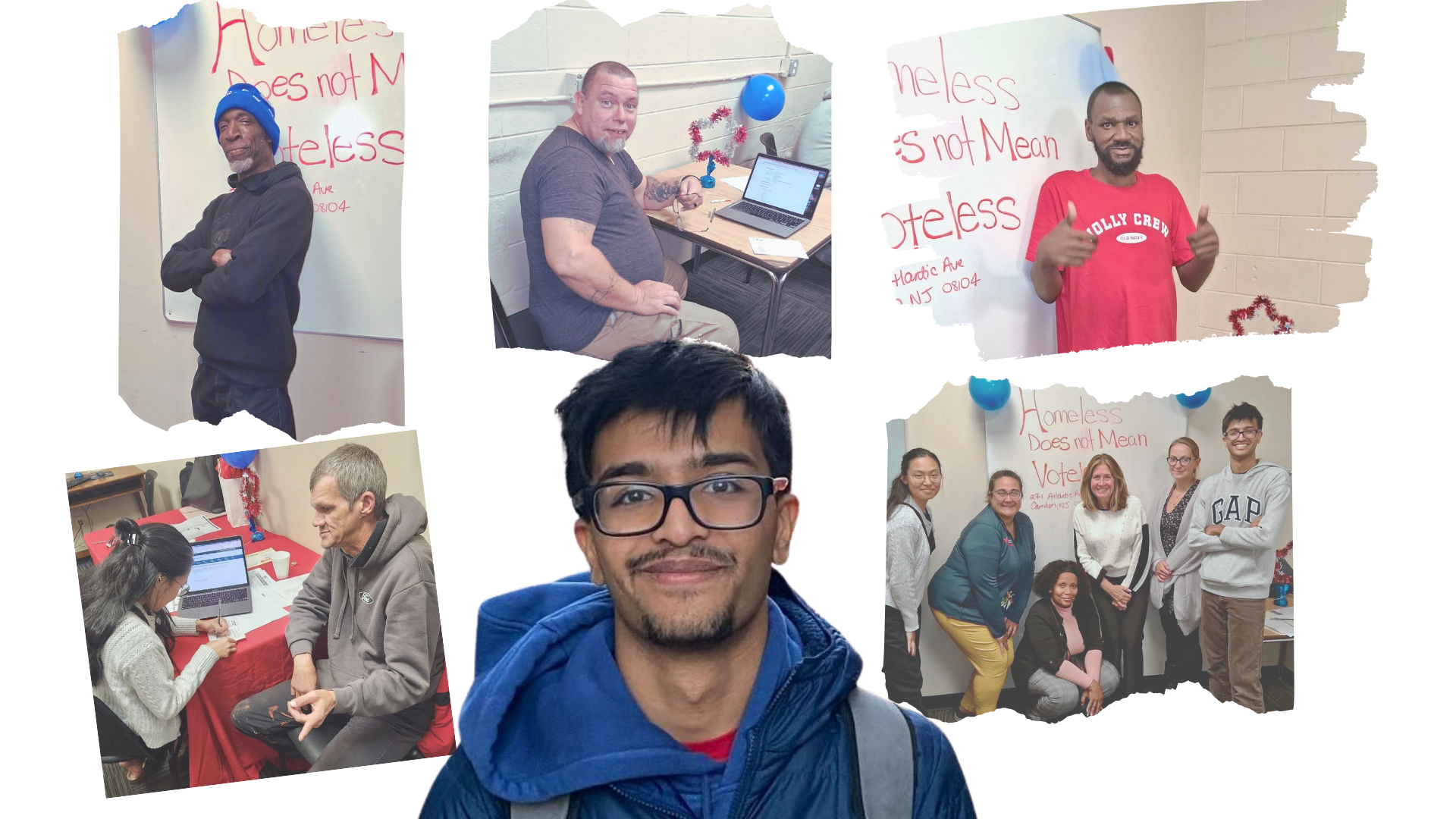
Voter registration at a Homeless Shelter - Camden County, NJ
For many people experiencing homelessness, voting is a logistical nightmare. Shelters across the country house communities that are deeply affected by public policy, particularly governmental decisions about housing assistance, local programs, and social services. Yet something as simple as casting a ballot can become complicated very quickly. People may not know where their polling place is, how they will get there, or even whether they are eligible to vote at all.
Prepare2Vote’s “Homeless Not Voteless” initiative exists to close that gap. The goal is simple: meet people where they are, help them register to vote, and make sure they leave with a clear plan for how they will actually get to the polls.
For some people, focusing civic engagement efforts on the homeless might seem counterintuitive. When thinking about increasing civic participation, it can feel more efficient to focus on voters who are already economically stable or consistently engaged in politics. Others assume that people struggling with homelessness do not have the time or resources to meaningfully participate in elections.
But that assumption runs against the spirit of democracy itself. Acting as though we know what is best for communities without hearing directly from them is part of why so many governmental policies end up missing the mark. People experiencing homelessness are rarely present in the rooms where political decisions are made about their future.
What we are doing now as a country to address poverty is clearly not working. The persistence of homelessness in cities across the country, well beyond Camden, shows that the current system is failing the very people it is meant to help. Expanding civic participation among the homeless community may be one of the few ways to ensure that policies are shaped by the voices of those most affected by them.
Public conversations about poverty often drift into discussions of addiction, even though the two are not the same. In those conversations, people sometimes talk about “gateway drugs”—first steps that lead deeper into dependency. Civic participation can have the opposite effect. Voting can be a gateway into self-empowerment, allowing homeless Americans to have a voice in what happens within their own communities.
That belief in the gateway power of participation is what brought me to volunteer with the initiative at a shelter in Camden. Our goal that day was to remove some of the practical barriers that stand between people and the ballot box. Registering someone to vote, while noble, was only the first step. With each person we met we also helped create a plan for Election Day—looking up polling locations, figuring out transportation, and helping newly registered voters chart out exactly how they would get from their place of residence—whether it be the shelter or somewhere else—and to an election booth. If someone leaves with a clear plan on how to vote, we thought, they’re far more likely to actually follow through to the polls.
We were right. After only an hour of work, more than 30 people we worked with ended up casting a ballot.
What struck me most during the day was how meaningful the act of voting was to people who had often been told—explicitly or implicitly—that their voices did not matter. One man, Jermaine, came up to our table convinced that he had permanently lost the right to vote because he had previously been incarcerated. Someone had told him that once you go to prison, your voting rights stay locked up even after you are released. But in New Jersey, that simply is not the case. As long as someone is not currently incarcerated, they can vote, even if they’re on probation or parole.
When we explained that to him, he paused for a moment, almost like he was trying to figure out whether he had heard us correctly. Then his whole face changed. He started smiling, laughing a little in disbelief, repeating back what we had just told him as if he needed to hear it out loud again: So I can vote? I can actually vote?
A little later, while we were filling out the registration form, he mentioned something that stuck with me. He said his mom had always told him that no matter what happened in life, voting was important. Listening to him say that made me think about the version of Jermaine his mother must have seen when he was a kid. At some point he had just been her little boy, someone she was raising in this country and hoping would grow up to take part in it, to have a voice in it. Whatever else had happened in his life since then, that was still part of him.
For years he had believed that part was gone. He thought prison had cut him off from it permanently, that he had somehow forfeited his place in the civic life of the country he was born and raised in. Finding out that he hadn’t clearly meant something to him.
Once he realized it was real, he didn’t keep it to himself. He started calling people over almost immediately. Friends from the shelter came up to the table, and then more people followed. One conversation turned into several in a matter of minutes. You could almost watch it spreading as people told each other to come talk to us.
Prepare2Vote had come in hoping to help people navigate a few logistical barriers to voting, but watching Jermaine bring others over made it clear how quickly civic participation can ripple outward. In the span of a single afternoon, one person realizing he hadn’t lost his voice led to several others registering and making their own plans to vote. If one evening can build momentum like that in real time, it shows there’s real reason to believe the “Homeless Not Voteless” initiative has the potential to continue spreading in the same way. - Ali Sabir