
What exactly is Congress and how does it impact me?
Overall, the U.S. Congress plays a crucial role in shaping national policy, enacting laws, and providing a forum for debate on important issues. Of the 3 branches of Government, this is the Legislative Branch. The Legislative branch is where laws originate before the go to the President to be sign (or not) and enacted as law.
Congress is made up of two houses:
Senate:
Consists of 100 members, with each state having two Senators regardless of its population,
serve six-year, staggered terms; and
has specific powers, such as confirming presidential appointments and ratifying treaties.
House of Representatives:
Consists of 435 members, with the number from each state based on its population, (based on the census!)
serve two-year terms,
has the exclusive power to initiate budget bills; and
has the authority to impeach federal officials.
Representation:
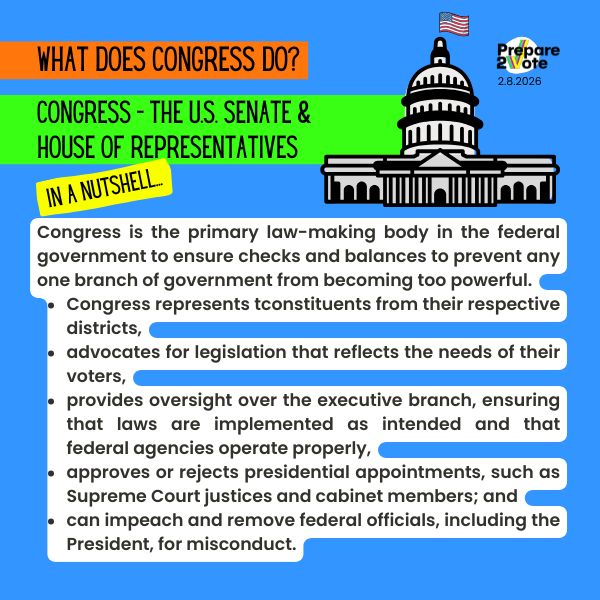
Members of Congress represent the interests of their constituents from their respective districts or states; and
they advocate for policies and legislation that reflect the needs and preferences of their voters.
Constitutional Role:
Congress is established by Article I of the U.S. Constitution. It is designed to be the primary law-making body in the federal government and operates as part of the system of checks and balances intended to prevent any one branch of government from becoming too powerful.
Congress exercises oversight over the executive branch, ensuring that laws are implemented as intended and that federal agencies operate properly,
it has the power to approve or reject presidential appointments, such as Supreme Court justices and cabinet members; and
can impeach and remove federal officials, including the President, for misconduct.
Legislative Process:
Introduction of Bills: Members of Congress can introduce bills (proposed laws). These bills can be introduced in either chamber.
Committee Review: Bills are referred to committees within each chamber, where they are studied, debated, and amended.
Debate and Voting: Bills that pass committee review are debated on the floor of the chamber where they were introduced.
Members vote on the bills, and if passed, they move to the other chamber for consideration.
Conference Committee: If both chambers pass different versions of a bill, a conference committee may be formed to reconcile the differences.
Presidential Approval: Once both chambers agree on a final version of a bill, it is sent to the President for approval or veto.

https://commons.wikimedia.org/wiki/User:AveryTheComrade